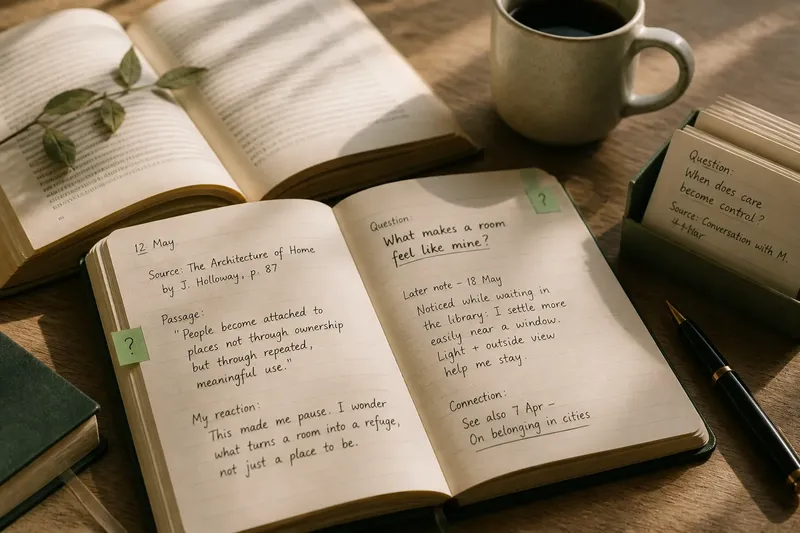
A Gentle Sunday Review for a Week in Motion
A Sunday review for a week in motion helps you notice which commitments still fit, what needs clarification and what deserves a deliberate conversation.
The common mistake in a Sunday review is treating the week as a verdict: productive or wasted, on track or off course. That judgement can hide a more useful question: which commitments still fit the life you are actually living? A Sunday review for a week in motion can help you distinguish a genuine change in direction from a temporary disruption.
Bring a notebook and your calendar, whether it is on paper or in Google Calendar. Rather than setting intentions for the week ahead, use the page to examine the agreements, responsibilities and expectations already shaping your days.
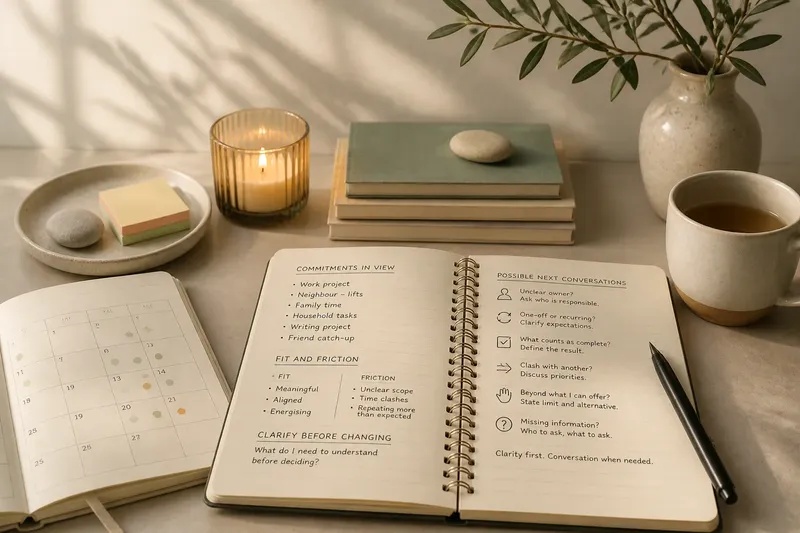
Commitments in view
List the commitments that occupied your attention: work, care for other people, household tasks, friendships and personal projects. Include informal promises as well as scheduled appointments. A calendar shows where time went; your notes can show what each commitment meant to you.
For each item, write a plain observation. “I stayed late twice to finish a shared task” is more useful than “work is taking over”. The observation does not decide whether the commitment should continue. It gives you something specific to consider.
Fit and friction
Notice where an obligation aligned with what matters to you, and where it created friction. A difficult task can still feel meaningful; an enjoyable activity can still leave too little room for other responsibilities. Avoid treating comfort as the only measure of fit.
Look for differences between what you agreed to and what you are actually being asked to do. Perhaps a favour has become a recurring duty, or a project has changed scope. The useful question is not simply whether you can cope, but whether the current arrangement is clear and sustainable for everyone involved.
Clarify before changing
Some unease points to a need for a conversation rather than an immediate decision. Identify what you do not know: who owns a task, what “finished” means, or whether a commitment is still expected. Write the question in concrete terms so you can ask it without turning an uncertain impression into an accusation.
Say you had agreed to help a neighbour with occasional lifts, and this week you were asked to drive on several mornings. In your notebook, record the original understanding, the new requests and the practical conflict with your own appointments. Then ask whether the neighbour expects regular help or is asking only for this week; the answer tells you whether to discuss a standing arrangement or simply respond to a temporary need.
Commitment review questions?
How can I tell whether a commitment still fits?
Compare what you agreed to with what it now requires, then ask whether its purpose still matters to you. If the purpose remains but the arrangement has become unclear, seek clarification before deciding to withdraw.
What if I feel guilty about setting a boundary?
Separate the feeling from the practical question of what you can reasonably offer. State your limit plainly and, if appropriate, describe what you can do instead; guilt alone does not establish that you have made the wrong choice.
Should I make a decision during the review?
Decide only when you have enough information and the decision is yours to make. If another person’s expectations or responsibilities are involved, note what needs discussing rather than treating a private Sunday reflection as a substitute for that conversation.
What should I write if nothing stands out?
Record that the week’s arrangements seemed broadly consistent, then note any commitment you want to understand better. A review can clarify what is steady without inventing a problem to solve.
Possible next conversations
Use the notes to identify whether each concern calls for a clarification, a boundary, a change in your own approach or no action for now. This list keeps the decision connected to what you observed:
- If a task’s owner is unclear, ask who is responsible; if ownership is already clear, use the agreed route for updates instead.
- If a request has become recurring, ask whether it is now a regular expectation; if it was a one-off, decide whether you can answer this instance on its own.
- If the expected result is vague, ask what counts as complete; if it is already defined, compare the request with that definition before taking on more.
- If a commitment clashes with another obligation, identify the conflict and discuss priorities with the people affected; if there is no real conflict, keep the existing arrangement.
- If you have agreed to something you cannot reasonably provide, explain the limit and offer a workable alternative when you can; if you can still meet the agreement, follow through without adding a new condition.
- If you lack information that would change your decision, write down whom to ask and what to ask; if the missing detail would not affect the decision, avoid prolonging the review.
A Sunday review for a week in motion is most useful when it leaves you with a clearer account of what you agreed to and what remains uncertain. Keep that account available when a conversation is due. The practical value is not a tidier week, but a more honest basis for deciding what you can continue to offer.