The Values Hidden in a Repeated Choice
Repeated everyday choices can reveal values more clearly than abstract labels. Notice the pattern, name what it protects, and choose what to do next.

The common mistake in identifying personal values is reaching for an admirable word before looking at ordinary behaviour. “Creativity” or “community” may sound right, but a label on its own can conceal the choices that actually shape a day. Repeated choices offer firmer ground: they show what a person keeps making room for, and what that habit may be costing elsewhere.
A values reflection need not turn every preference into a grand principle. It can begin with a small, recurring decision: answering a colleague promptly, taking the longer route through a park, keeping plans with a friend, or postponing a task until there is time to do it carefully. The point is not to judge the choice. It is to notice what it consistently serves.
Choices as clues
A value is easier to recognise through its effects than through its name. If you repeatedly make room for a difficult conversation, honesty or repair may matter to you. If you keep setting aside an unfinished task to help someone, care or dependability may be involved. Several values can sit behind the same action, so a pattern is a clue, not a verdict.
It also helps to distinguish a chosen commitment from a response shaped by pressure. Someone may say yes to every request because generosity matters, but also because saying no feels unsafe or uncomfortable. The outward choice looks similar; the reason and its consequences differ. Ask not only, “What did I choose?” but, “What was I trying to preserve, express or avoid?”
Three ways to observe
There are several useful approaches to this reflection. Each suits a different kind of person and produces a different sort of evidence.
Notice as you go
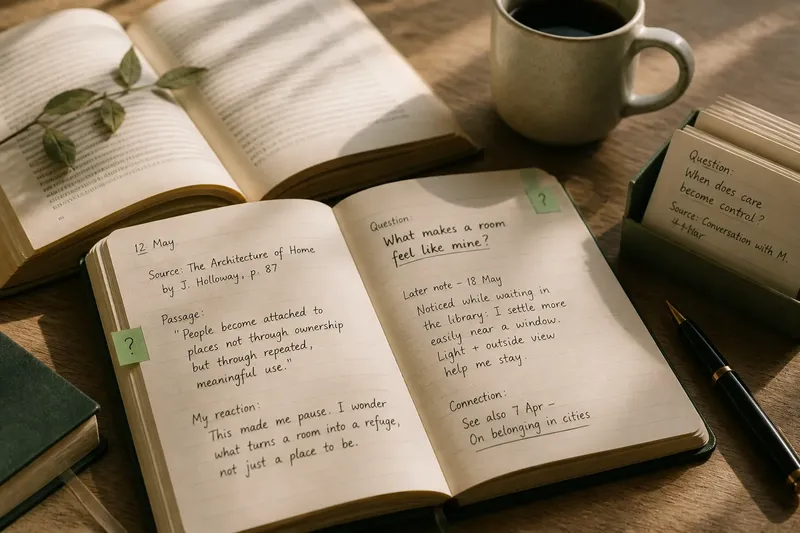
For a week or so, pause after a choice that feels familiar and jot a few words in a notebook or phone note. Record the situation, what you did and what seemed to matter in that moment. This suits someone who likes close observation, though it can become burdensome if every small decision receives an entry.
Look back in batches
Set aside a quiet moment and recall a handful of recent decisions that stayed with you. Consider moments of satisfaction, irritation or reluctance; strong feelings often point to something being honoured or crowded out. This approach suits someone who prefers reflection to frequent note-taking, but memory may favour the most striking moments over the most typical ones.
Ask someone you trust
Invite a thoughtful friend to describe a choice they have seen you make repeatedly and what it appears to protect. This can reveal a pattern you take for granted, especially if your own labels feel vague. It suits someone open to another perspective; the other person’s reading remains a prompt, not an authority on what you value.
Choose one approach rather than trying to use all three at once. If the pattern is hard to remember, brief notes can help. If writing makes you self-conscious, look back in a single sitting. If you have reached the same uncertain interpretation several times, a trusted outside view may add useful contrast.
A simple observation exercise
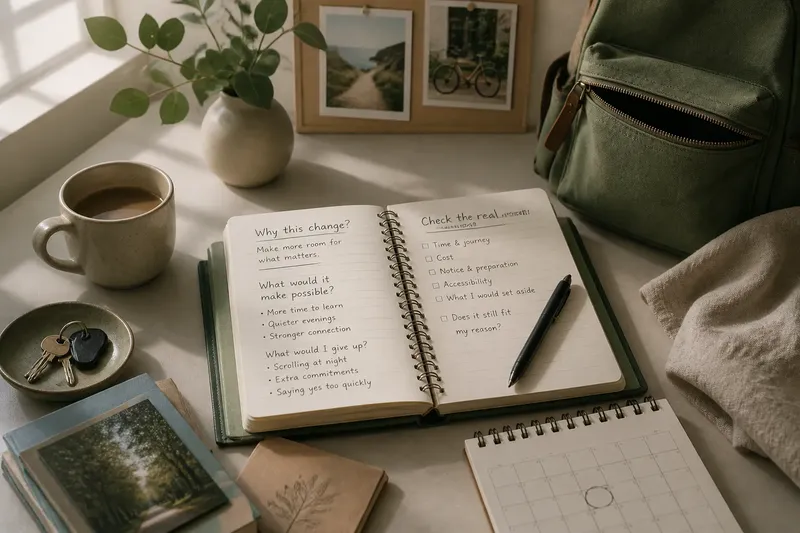
For a short stretch of ordinary days, notice choices that recur or leave a mark. You might use a pocket notebook, a notes app or the back of a calendar. Keep the record plain; this is not a diary of everything that happened.
- Situation: What was happening, in a few words?
- Choice: What did you do, or decide not to do?
- Reason: What did you hope to support, protect or avoid?
- After-effect: Did the choice leave you settled, strained, resentful or glad?
- Repeat: Have you made a similar choice in another setting?
Say you often use your lunch break to help a teammate sort out a confusing task, then feel irritated when your own work runs late. The repeated choice might point to generosity, but the irritation suggests a second value—perhaps fairness or having enough room to do your own work. Naming both gives you a more useful picture than declaring yourself “helpful” and stopping there.
When a few entries seem connected, write a plain-language description of the pattern before choosing a value word. “I keep making time to explain things so nobody is left guessing” is more specific than “I value kindness”. Possible names might include clarity, care or shared understanding. The sentence preserves the evidence; the label helps you carry the insight into other decisions.
From pattern to meaning
Use three questions to test an interpretation:
- Does this value fit more than one example?
- Does it describe what I choose, rather than only what I admire?
- Does it still feel like mine when the choice is inconvenient?
A value may be present even when you do not act on it. Someone can care about rest and still accept another commitment; the mismatch may reflect pressure, habit or competing responsibilities. Treat that gap as information about the circumstances, not as evidence that the value is false.
Repeated behaviour can also point to comfort, duty or a practical constraint rather than a freely chosen value. Returning to the same familiar task might reflect genuine craft, or simply a lack of permission to try something else. If the interpretation feels too neat, leave it open and notice what happens in a different context.
Which approach fits you?
How long should I observe my choices?
Observe long enough to notice a repeat, without turning the exercise into a permanent assignment. The right span depends on how often the choice comes up; a rare decision may need a longer look than a daily habit.
What if my choices seem to conflict?
Look for two values competing for the same time or attention. A conflict does not make either value insincere; it may show where a more deliberate boundary or trade-off is needed.
Can an unwanted habit reveal a value?
It can offer a clue, but repetition alone does not make a habit a value. Ask whether the habit expresses something you care about or mainly reduces discomfort, meets an expectation or fills an unchosen default.
What should I do once I name a pattern?
Choose one small decision where the value could guide you more deliberately. Keep the adjustment modest enough to observe what changes in your experience, then reconsider the interpretation if it does not fit.
Choose your next question
The best approach is the one that helps you see a pattern without making you perform for the notebook, the friend or an idealised version of yourself. Notes suit close attention; a retrospective suits a quieter, less frequent review; another person’s perspective suits a pattern you cannot quite see alone. Begin with the option that feels easiest to return to, not the one that sounds most rigorous.
Once you have a possible value, carry its description into one upcoming choice. Ask what it would look like in practice, and what it might ask you to decline or protect. The values hidden in repeated choices become clearer when a name leads to a usable question—not a fixed identity, but a way to decide what deserves room today.