Before the Bucket List: The Quiet History of Keeping a Commonplace Book
A commonplace book for questions turns reading into a record of curiosity, helping you trace how a puzzling idea changes across books and ordinary life.
The common mistake with a commonplace book is to treat it as a scrapbook of impressive quotations; the cost is a handsome record that preserves other people’s words but not your own line of thought. A commonplace book for questions gives the page a different job: it follows an idea as it changes between a text, a conversation and an ordinary observation.
A working collection
A commonplace book is a personal collection of material worth keeping: a passage, a distinction, an image, an argument or a thought prompted by something encountered in daily life. It need not follow the calendar like a diary, and it need not be a catalogue of quotations. Its entries can include your disagreement, a connection to another source, or the question you cannot yet put aside.
Readers have long copied and arranged passages for memory, study and later use. The practical point is not the history of famous owners, but the habit of treating notes as working material rather than decoration. A bound notebook, loose index cards or a plain-text file can all hold ideas that have not yet found their proper place.
For a question-centred book, the source matters because it lets you see where an idea began. Your response matters because it shows what the idea did once it reached you. Without either, a copied sentence may become difficult to understand when you meet it again.
Questions over milestones
A list of ambitions points towards completed acts: places to visit, skills to acquire, milestones to reach. Questions preserve a different kind of movement. They let an unfinished encounter remain open without requiring it to become a project or resolve into a neat answer.
Instead of saving only a polished sentence, note the question it leaves behind: What makes a place feel welcoming? Why do certain instructions settle me while others irritate me? When does care become control? These are specific enough to revisit, but broad enough to follow across a novel, a conversation or a walk.
Questions also make it possible to notice when an idea changes shape. “What makes a place feel welcoming?” might begin as a response to a description in a book, then become a question about how people share space. The value is not that the question commands action. It is that the wording gives you something to compare as your thinking develops.
From source to question
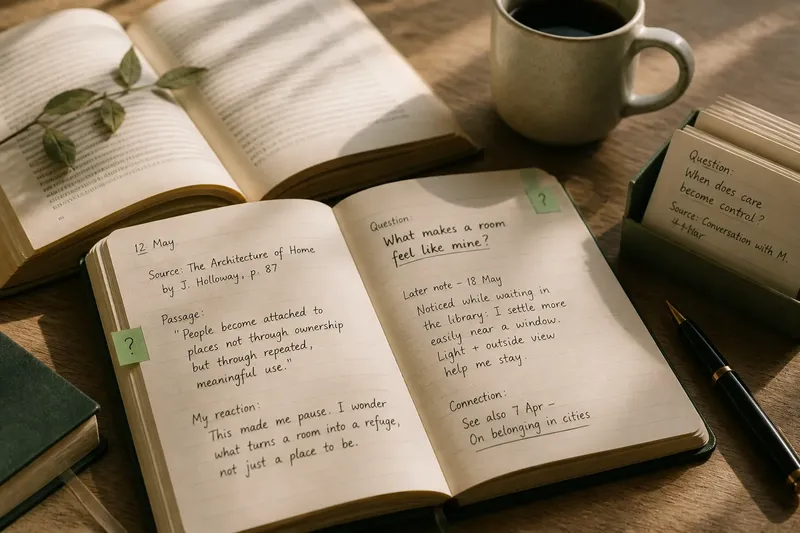
When something catches your attention, record enough context to recognise it later. Note the source and subject, then write what made you pause. Turn that response into a question in your own words. The entry can be brief, but its parts should help future-you understand why it was kept.
- Check the source. If you can name the book, article, speaker or place, record it; if you cannot, describe the context you do remember and avoid presenting the wording as an exact quotation.
- Check the length. If a short passage carries the idea, copy that passage; if the source runs on, paraphrase the point so your own note remains easy to scan.
- Check your response. If you can name what surprised, irritated or clarified you, write that reaction; if not, note the specific detail that held your attention.
- Check the question. If it invites you to notice or compare something, keep it; if it demands an immediate verdict, soften it into a question you can return to.
- Check for a connection. If another entry touches the same idea, add a page reference, link or tag; if none comes to mind, leave the note unlinked rather than inventing a category.
- Check the filing effort. If you can find entries with a date, index or one simple tag, keep that arrangement; if sorting takes longer than writing, remove categories and use a chronological sequence.
Paper and digital formats support different habits. A notebook keeps entries in sequence and makes marginal comments easy; index cards let you rearrange a cluster of questions; Apple Notes, Obsidian or a plain-text file can search terms and link sources. The choice is not a test of seriousness. Pick a form that lets you capture an idea without first solving how the whole collection should be organised.
When curiosity returns
Say you read an invented passage in a library book about people becoming attached to familiar places. You record the title and page, write that the passage made you wonder what turns a room into a refuge, then add the question, “What makes a room feel like mine?” Later, while waiting in a library, you notice that you settle more easily near a window and add that observation beside the entry. The result is a question with a new detail attached, not a rule about where you must live.
A returning question can gather details from many parts of life: a phrase that complicates your first response, an exception that resists an easy answer, or an observation that gives the question a sharper edge. This is personal note-making, not a formal study. The point is to preserve the relationship between the source, your reaction and what you notice afterwards.
When a question returns, ask what kind of curiosity it carries. Does it want a fact, a comparison, a conversation, a creative experiment, or simply more time? “What makes a room feel like mine?” might prompt reading about domestic space, a conversation with a friend or no action beyond noticing which places invite you to stay. Each possibility can remain on the page without being converted into a target.
Choosing a structure
A chronological notebook shows the path of your thinking as one entry follows another. A subject index or a few tabs can help when you want to find a recurring theme. Digital notes make it easier to connect one question with several sources, though elaborate tags and folders can turn every new thought into a filing problem.
Begin with a small structure and change it when a real difficulty appears. You might reserve the first page for an index, mark questions with a question mark in the margin, or add “returned to” beside a later note. In an app, one tag such as “question” may be enough. If you cannot find a note, add a useful subject heading; if you can find it, there is no need to redesign the system.
Keep copied material in proportion to your own response. A few lines with a source note and an honest comment often preserve the encounter better than a page of transcription. The collection is yours not because every sentence is original, but because you record what you noticed in it.
Commonplace book questions?
What belongs in a commonplace book for questions?
Keep a passage, observation or idea that makes you pause, with enough source context to recognise it later. Add your response and a question that names what remains unsettled or newly interesting.
Is a commonplace book different from a journal?
A journal often follows the events or feelings of a person’s life, while a commonplace book gathers material from different sources for later thought. The forms can overlap when you place personal observations beside what you read.
Should I organise entries by topic?
A chronological sequence is simple to maintain and may reveal connections gradually; an index or a few tags help when you need to retrieve a subject. Start with the arrangement you can use without pausing to classify every entry, then adjust if finding notes becomes awkward.
What if a question stays unanswered?
An unanswered question can still record a meaningful encounter with an idea. Leave it open, revise it when your understanding shifts, or let it rest without treating resolution as the measure of a useful entry.
Leaving questions unfinished
A commonplace book for questions keeps the middle of thought visible: the hesitation after a sentence, the objection you cannot yet explain, or the detail that changes a familiar idea. Its usefulness lies less in collecting answers than in letting you see how a question moves from its source into your own experience.
When you return to an entry, read the source note and your first response before adding anything new. That small order can show whether the question still means what it once did, or whether a later observation has quietly changed it.